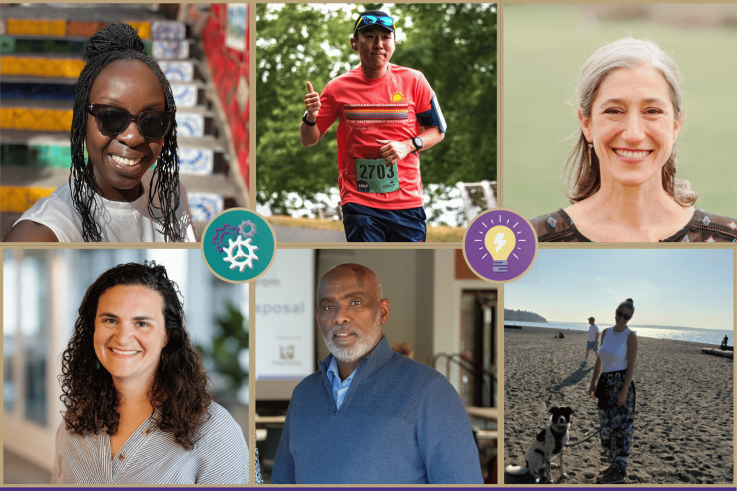
Public health careers do not always come with a public health label and graduates often forge their own paths, in service to the idealism and commitment to health that first inspired them down a global health path. Some could not have predicted on their first day of class where their career would take them. Our alumni engagement committee sat down with us to share their career path and how they are still committed to health for all.
Answers have been edited for length and clarity.
Thanks for sitting down with us. Can you introduce yourself and share where you currently work and what your job entails?
Mohamed Ali, Master of Public Health, Class of 2008: I am an Environmental Public Health Planner, Public Health Seattle & King County. I work on strategic planning, working with communities and local governments, developing countywide strategies, using data to inform decisions, and helping to make Puget Sound the cleanest, healthiest, and safest from hazardous materials.
Kyle Daniels, Doctor of Global Health Leadership and Practice, Class of 2025: I work on the Partner team at Truveta, which is a startup headquartered in Bellevue. In my role, I manage partnerships with life sciences organizations to help them design and execute real-world evidence studies using healthcare data. Our dataset represents 1 in 3 Americans allowing for new research insights and health innovations.
Claire Gwayi-Chore, PhD in Implementation Science, Class of 2022: I am a Senior Office for Measurement, Learning and Evaluation at the Gates Foundation. Some days I am building surveys, conducting analyses, or drafting insight reports; other days I am facilitating presentations with teams or leadership, developing strategy materials, or helping teams think through how they can use evidence to inform decisions
Jiho Kim, PhD in Pathobiology, Class of 2020: I am a scientist at PAI Life Sciences Inc. My work is mostly in the lab, performing experiments on vaccine candidates against neglected tropical diseases such as schistosomiasis. I’m involved in verifying whether the vaccines work well in disease models, and how we could eventually move it further down the clinical development pipeline.
Julia Robinson, Master of Public Health/Master of Social Work, Class of 2008: I am currently the Executive Editor for PLOS Global Public Health. I do everything from shape editorial strategy and content with my editors, to commission thought leadership pieces for the journal, to making scientific decisions on manuscripts and policies.
Katherine Shulock, Master of Public Health (Peace Corps Masters International), Class of 2020: I am a Communications Lead for Avian Influenza at the Washington State Department of Health. I work with zoonotic epidemiologists, veterinarians, and equity experts to ensure that information and guidance on bird flu is engaging, accessible and actionable. This could mean updating the public facing website, translating health education resources into Washington’s top languages, or developing multi-media awareness campaigns for priority populations.
Service is often touted as a part of a career in public health. How do you feel service is part of your career?
Mohamed Ali: My MPH taught me more about society and health, social determinants of health, health equity, advocacy, systems thinking, and working toward system improvement for all. These lessons helped me take on community health advocacy and contribute to improving a health system built for dominant cultural groups that maintained the status quo.
Jiho Kim: I am working on neglected tropical diseases. Neglected is in the name - there are fewer resources dedicated to the efforts against such significant diseases. Being able to work on a neglected disease makes my efforts all the more worthwhile.
Julia Robinson: I love that I can use my experience and position to amplify and platform scholars from underrepresented regions and help provide a space for ideas and scholarship that may have struggled to find a home prior to coming to the journal.
Are you ever surprised by the ways your education has prepared you for your career?
Claire Gwayi-Chore: I have been surprised by how much of the skill set I developed during my PhD shows up in my day-to-day work. Writing, editing, synthesizing complex information, managing feedback, navigating ambiguity, and leading complex processes with people at different levels of an organization are all skills I use constantly. In fact, managing a dissertation committee turns out to be surprisingly good preparation for working with a director-level cohort!
Kyle Daniels: Definitely! While at UW, I became interested in how cross-sector partnerships can improve population health. That led me to Truveta, where I get to combine my public health training with my passion for facilitating partnerships that advance research.
Julia Robinson: I had never held a job in publishing before, so it was a pretty big learning curve! It was really good timing, though, because I started at PLOS just as PLOS Global Public Health was really gathering steam, so I was able to take my skills and experience I had developed in global health and combine them with my new skills in publishing, and the rest is history!
This is tough job market with so many changes to public health policy and funding. What advice would you give to people job searching?
Kyle Daniels: Don't be afraid to explore careers outside of traditional public health settings. Your skills are valuable across healthcare, technology, and the life sciences. Stay curious, build relationships, and be open to opportunities that let you keep learning regardless of whether it’s what you had in mind.
Mohamed Ali: Don't just focus on getting your next job. Instead, build your skills, relationships, and reputation for long-term success. Your career path might not be a straight line, but if you act with integrity, work well with others, and stay committed to public service, good opportunities will come your way
Katherine Shulock: Stay open to opportunities, even when they don’t look exactly like the path imagined. Some of the most meaningful work can come from unexpected turns. I got connected to the DOH when a colleague from the Peace Corps connected me to someone there. When I shared my experience working on HIV in Botswana, my future boss saw a good fit for the COVID response team.
What about networking?
Julia Robinson: Your biggest asset will be the network of people that you have built throughout your studies, internships, and beyond - use these people to bounce ideas off of, plant seeds for future collaborations, and to remind each other that you stand in solidarity. In a difficult job market, your network and your belief in what you bring to the table can carry you farther than you think.
Claire Gwayi-Chore: Global health is a surprisingly small world, and the people you meet at UW, conferences, internships, previous jobs, and through professional organizations often remain connected to one another in ways you don't anticipate. For my current job with the Gate Foundation, a current Foundation employee shared the role with me and submitted a referral on my behalf.
Let’s end on a high note, what’s the best part of your job?
Mohamed Ali: The best part of my job is seeing ideas become real changes in communities.
Claire Gwayi-Chore: I really enjoy being surrounded by people who are deeply passionate about their work. People are generally very willing to share what they're working on, explain something you may not know, or bring you into a conversation. There is an almost unlimited amount of inspiration around you.
Kyle Daniels: For me, the best part is working at the intersection of public health, healthcare, and technology while supporting research that has the potential to improve patient care and outcomes.
Jiho Kim: Knowing that some of the vaccines and therapeutics I work on could eventually make it to people that need them!
Julia Robinson: On any given day I can interact with people from all over the world, incredible leaders who are really shaping the future of global health policy and advocacy
Katherine Shulock: I love being part of a team that cares deeply about getting information right and making it understandable for different communities. It feels good to create resources that people can actually use.
Thank you to our alumni who have been generous with their time, advice, and perspectives helping us to build a more engaged alumni community to strengthen the network of DGH Huskies.