From environmental disasters, heated conflicts between countries and disease outbreaks, one word keeps popping up across headlines, research articles, and policy discussions: resilience – a concept deemed critical to addressing the complex challenges faced by humanity.
Various resilience frameworks have highlighted the necessity of resilience across system, sectors, and levels (SSLs), where systems and sectors represent larger institutions, such as the health system, and levels represent smaller groups, such as communities or individuals.
During the COVID-19 pandemic, the health system led diagnosis and treatment, but effective response required coordination with transport, social welfare, and education systems. Beyond the health system, collaboration with disaster management sectors and the built environment was essential, while resilience actions spanned levels, from individual behaviors such as mask wearing, to community measures like limiting gatherings, and societal policies including social protection and economic support.
However, translating this understanding into coordinated action among these groups remains a challenge, which Novil Wijesekara, a student in the Doctor of Global Health Leadership and Practice program, experienced in Sri Lanka.
“Everyone knows that we need to work together to overcome disasters,” Novil shared. “But during the 2004 tsunami, 30-year internal conflict in Sri Lanka, and Easter Sunday attacks, I wasn’t seeing that happen. Communities and partners failed to work together; critical opportunities to rebuild, reduce future risk, prepare more effectively for future emergencies, and advance broader development were missed.”
These experiences influenced Novil’s recent article in Disaster Medicine and Public Health Preparedness, where he identifies what keeps SSLs from being resilient and proposes a philosophical yet actionable framework as a solution.
Bridging the Gaps
Combining a review of literature with his lived experience in disaster and systems response, Novil identified seven recurring, interconnected gaps that create barriers between SLLs, and seven prerequisites bridge each gap: shared challenges, shared elemental resilience energies, shared synergistic resilience opportunities, shared partner identification, shared directions, shared values, and shared leadership.
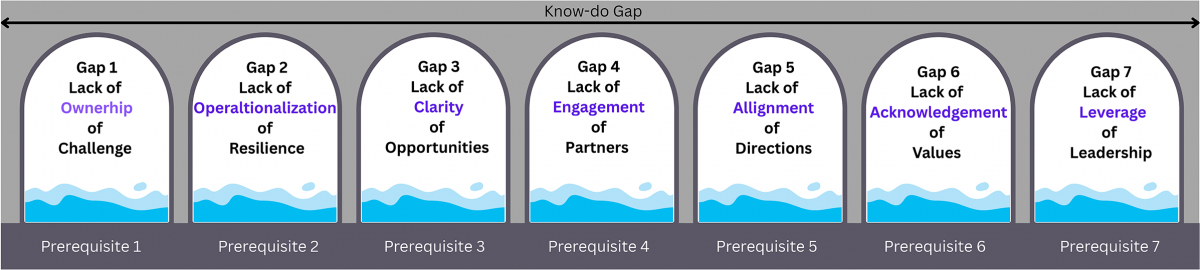
If SSLs can achieve the seven prerequisites, it leads to Synergistic Resilience – the ability of people, communities, and systems to work together in a connected way to prepare for, respond to, and recover from challenges, achieving stronger results than any one group could on its own.
Novil captures this sentiment with the equation 1+1=3, representing how combining efforts across groups creates a collaborative approach that is stronger than the sum of its parts and amplifies resilient outcomes.
“SSLs don’t benefit if they work in silos,” shared Novil. “But let’s say a community works with their health system to be better prepared for a tsunami. They discuss evacuation routes, which hospitals will be open during a disaster, and strategies to transport injured family members. Now the community is prepared for a tsunami, which benefits them, but it is also an asset to the health system, because there will be less injured community members in the hospital.”
Drawing on the Four Elements
Wanting to create a framework for promoting Synergistic Resilience that could be easily translatable across cultures and levels of education, Novil was inspired by the elements.
“Since childhood, growing up in Sri Lanka, I was fascinated by narratives around the four elements—earth, water, air, and fire—which are deeply rooted in South Asian philosophical traditions, where they are known as the Mahābhūta (great Elements) and used to explain the nature of the physical and experiential world,” reflects Novil. His framework was influenced by the four elements and how their understanding can be used to solve practical problems as well as philosophical ones.
While studying resilience at the UW, Novil found that the four elements – earth, water, air and fire – were often synonymous with how some people defined resilience, and could be used to create a framework that crosses barriers, influencing him to incorporate the elements into his framework.
The elements are part of his Synergistic Resilience Compass (SRC)—a structured, practitioner-focused framework designed to guide SSLs through the process of achieving each of the seven prerequisites, leading to Synergistic Resilience.
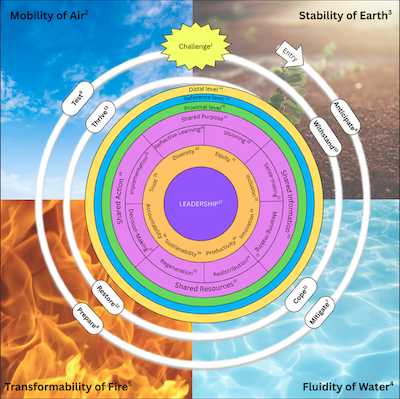
One of the steps of the SRC asks SSLs to analyze the challenge they are facing, and identify which aspect(s) of resilience they need to focus on by relating it to the qualities of the four elements: stability of earth, fluidity of water, transformability of fire, and/or mobility of air.
The early days of the COVID pandemic, still fresh in people’s minds, provided clear examples.
“Our hospitals had to be strong and robust like earth energy, but people had to be flexible and fluid like water,” Novil shared. “We had to adapt and pivot to virtual meetings. Systems that no longer made sense, like in-person meetings, had to be destroyed like fire, and out of thin air we had to come up with new solutions like virtual meeting venues.”
From Theory to Action
By incorporating the elements into his framework, Novil hopes that the SRC can serve as a practical, adaptable tool that can be readily translatable across cultures and levels of education, and help SSLs advocate for, plan, and manage resilience initiatives in response to today’s demanding challenges in a 1+1=3 way.
And while his article focuses on the uses of the SRC amongst global health crises, the framework is not limited to disaster, pandemic, or disease response.
“I wanted to make this framework as broad as possible, because at the end of the day, no matter what area you are working in, human nature is going to be a factor. What we need is not more fragmentation – we want people to come together.”
In Washington State, the SRC could be applied to reduce earthquake risk from unreinforced masonry buildings by aligning action across systems, sectors, and levels. At the individual homeowner level, seismic retrofitting may be perceived as costly and burdensome, but community and neighborhood organizations can ask questions, share information and collectively advocate for retrofitting funds. At the city level, clear guidance, incentives, and supportive policies can implemented, transforming a fragmented risk reduction effort into a coordinated, synergistic resilience strategy.
Next steps for Novil are to test his framework in real-life settings and document the benefits and limitations to improve the framework and adapt it into a full toolkit.