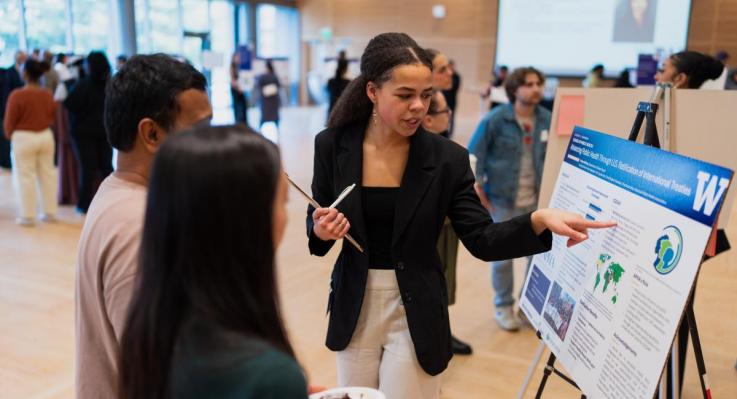
The MPH Practicum Symposium is an essential part of the MPH candidate experience as it enables our students to take what they’ve learned in the classroom and apply it to the real world of public health. This year, 24 DGH MPH students will be showcasing their innovative, community-driven projects at the 28th Annual MPH Practicum Symposium on Wednesday, April 8. Working with various local and global organizations, our students helped address some of the most pressing public health challenges of our time, and made lasting connections with public health agencies across the globe. Learn more about our students' practicum projects below.
Margaret Nickel | Perceptions of Quality of Maternal Health Care from the Patient and Provider Perspective
PRACTICUM SITE: Sinergias ONG SITE SUPERVISOR: Pablo Montoya DEPARTMENT: Global Health FACULTY ADVISOR: Steve Gloyd BIO: I am a second-year MPH student in the Department of Global Health, interested in Maternal and Child health topics, and project monitoring and evaluation. For my practicum project, I traveled to Colombia as a recipient of the Thomas Francis, Jr. Global Health Fellowship to work with Sinergias ONG. Sinergias is a non-government organization based in Bogota, Colombia, aiming to improve health care accessibility and quality in rural and indigenous settings within the Vaupes and Cauca regions of Colombia. For this practicum project, I aided Sinergias as they wrapped up data collection and performed data analysis for a monitoring and evaluation project at the Patia Municipality Hospital in the Cauca department of Colombia. My practicum activities included designing a Power BI dashboard to display key quantitative prenatal care indicators for the municipality’s use, in addition to designing and analyzing qualitative interviews to determine program acceptability for both patients and providers.
Maggie Venberg | Empowering Immigrant Parents of Teens: Curriculum Development for Social Emotional Learning and Rights and Advocacy in Education and Healthcare Systems
PRACTICUM SITE: PEPS SITE SUPERVISOR: Swarnima Aswinkumar DEPARTMENT: Global Health FACULTY ADVISOR: Alyson Littman BIO: My name is Maggie Venberg, and I am a second-year MPH student in Global Health. My research and implementation interests are primarily in child, adolescent, and parental health, and I completed my practicum with the PEPS organization in the greater Seattle area. PEPS was interested in expanding their Parents of Adolescents and Teens (PAT) Program to include an affinity group for international parents of teens. I completed a literature and web review, as well as a review of previous session topic guides, to create two new topic guides for this program expansion. The topic guides focused on social-emotional learning taught in WA public schools as well as information on rights and advocacy in schools, healthcare, and other public systems. The goal of these topic guides is to inform while focusing on shared knowledge to foster community building.
Amanda Debuo Der | Evaluating Innovations in Medication Abortion Services Through Qualitative Research to Document and Disseminate Best Practices for Efficient Adoption in the United States
PRACTICUM SITE: Department of Family Medicine/University of Washington SITE SUPERVISOR: Anna Fiastro DEPARTMENT: Global Health FACULTY ADVISOR: Sarah Munro BIO: I am a second-year MPH-Global Health candidate passionate about improving access to sexual and reproductive healthcare, including abortion care, contraception, and cervical cancer prevention, particularly in low-resource and restrictive settings. For my practicum, I worked with the Access, Delivered Research Initiative, and Women’s Health Research and Scholarship Lab, Department of Family Medicine/University of Washington. My project focused on evaluating innovations in medication abortion delivery and documenting patient experiences of traveling out of state for abortion care in the post-Dobbs context. Practicum activities included conducting a comprehensive literature review, analyzing qualitative interviews using Dedoose, and developing dissemination materials such as analysis memo, presentations for clinicians, community partners and researchers, and a conference abstract submitted to the National Abortion Federation. This experience strengthened my skills in qualitative research, health communication, and policy translation while deepening my commitment to advancing reproductive health equity globally.
Ricardo Moreno Garcia | Supporting various activities of Guanajuatenses en Washington, including mental health and Health disparities surveys and podcasts among the Hispanic population in King and Snohomish counties
PRACTICUM SITE: Guanajuatenses en Washington SITE SUPERVISOR: Guadalupe Zamora DEPARTMENT: Global Health FACULTY ADVISOR: Steve Gloyd BIO: My practicum focused on health disparities and mental health in the Hispanic community. l helped out collecting information to conduct a needs assessment through note-taking on talking circles around community members, implemented and analyzed data from qualitative and quantitative surveys, and worked and distributed information through a podcast.
Salome Marimbet | Mental Health Needs and Access to Care Among West African Immigrants in Washington
PRACTICUM SITE: Washington West Africa Center(WAWAC) SITE SUPERVISOR: PA Ousman Joof DEPARTMENT: Global Health FACULTY ADVISOR: Rabi Yunusa BIO: I am a second-year MPH student in global health with a focus on mental health equity among immigrant communities. I completed my practicum at the Washington West Africa Center (WAWAC), where I conducted a critical review of the 2024 Mental Health Study focusing on West African immigrants in Washington State. The project included analysis of qualitative interviews, staff surveys, and organizational materials to identify gaps in mental health literacy, stigma, and access to culturally responsive services. Findings were translated into actionable, culturally grounded recommendations to support program planning, outreach, and advocacy. This work highlights the importance of community-based, culturally informed approaches to improving mental health access and reducing disparities among immigrant populations.
Faraja Yusto Mgaya | Improving Maternal and Neonatal Health through Sustainable Mobilization of Clean Birth Kits with Misoprostol in Pwani Region, Tanzania
PRACTICUM SITE: Health Tanzania Organization and SEET (Socio-Economic Education Transformation for Health) SITE SUPERVISOR: Henry Ziegler DEPARTMENT: Global Health FACULTY ADVISOR: Ferdinand Mukumbang BIO: I am a second-year MPH student in the Department of Global Health and a trained medical doctor from Tanzania. My practicum with the Health Tanzania Foundation and SEET focuses on improving maternal and neonatal health in the rural Pwani Region through the sustainable mobilization of disposable clean birth kits with misoprostol. This project addresses inequities in access to essential delivery supplies that contribute to preventable maternal and newborn deaths in low-resource settings. As part of my practicum, I conducted a comprehensive literature review, designed a community mobilization strategy, and developed a grant proposal to support program sustainability. My practicum strengthens evidence-based approaches to maternal health, promotes community-driven interventions, and supports the integration of sustainable solutions within Tanzania’s health system to reduce postpartum hemorrhage and delivery-related infections for both mothers and newborns.
Yixuan Wang | Adapting China's '1-3-7' Malaria Surveillance Model for African High-Burden Contexts: Insights from Public Health Workers
PRACTICUM SITE: Peking University SITE SUPERVISOR: Minghui Ren DEPARTMENT: Global Health FACULTY ADVISOR: Yanfang Su BIO: As a Master of Public Health student at the University of Washington specializing in Global Health, I conducted my practicum at the Department of Global Health, Peking University School of Public Health, under the supervision of Dr. Minghui Ren. My project explored the adaptation of China’s “1-3-7” malaria surveillance model in high-burden African countries through qualitative interviews with frontline public-health workers from Gambia, Burkina Faso, Uganda, and South Sudan. Using thematic analysis, the study identified key barriers—such as fragile health systems, workforce shortages, and funding instability—as well as opportunities for China–Africa collaboration. The findings highlight strategies for phased implementation and capacity building to strengthen malaria surveillance and contribute to global elimination goals.
Alé Barrientos | Co-Constructing Care: Community Mental Health and Ethnographic Engagement in Dar es Salaam, Tanzania
PRACTICUM SITE: Health Tanzania SITE SUPERVISOR: Cyprian Chilowaka DEPARTMENT: Global Health FACULTY ADVISOR: Katarina Mucha BIO: I am a second-year Global Health MPH student with a concentration in epidemiology and a background in medical anthropology. My academic and professional interests center on structural violence, post-colonial societies, and community-driven health systems strengthening in global contexts. For my practicum, I partnered with SEET Tanzania and the Health Tanzania Foundation in Dar es Salaam to support the development of a culturally responsive, community-based mental wellness and self-care program. I conducted ethnographic fieldwork, including unstructured interviews and anthropological filmmaking, and documented success stories of orphans supported by SEET. I also contributed to organizational branding and communications and facilitated workshops to build local capacity in qualitative research methods. Grounded in Community Oriented Family Medicine principles, the practicum emphasized ethical global health practice, sustainability, and strengthening organizational tools for future program expansion and evaluation.
Brooke Erickson | Strengthening Mental Health Support in Ethiopia Through Faith-Based Collaboration
PRACTICUM SITE: Strengthening Care Opportunities Through Partnership in Ethiopia (SCOPE) Health SITE SUPERVISOR: Getahun Asres Alemie DEPARTMENT: Global Health FACULTY ADVISER: Brandon Guthrie BIO: I am a second-year MPH student in the Department of Global Health, with a focus on mental health systems strengthening in low-resource settings. My practicum was with Strengthening Care through Opportunities in Ethiopia (SCOPE) Health, an organization that employs a model connecting faith leaders, community health workers, and community members to promote health and well-being. My work focused on mental health, including validating a substance use assessment tool for the Ethiopian context, piloting a mental health treatment preferences survey, developing a post-implementation analysis on the sustainability of SCOPE’s Leading Advancements for the Uptake of Newborn and Community Health (LAUNCH) trial, and composing a call-to-action proposal for supporting internally displaced youth in Ethiopia grappling with mental health challenges, which commonly co-occur with conditions such as stunting and wasting, from the ongoing conflict. The completion of these deliverables was founded upon informal interviews with community members and local stakeholders.
Paola Armenta León | Understanding Climate Change Action and its repercussions in Public Health in Iquitos, Perú
PRACTICUM SITE: Healthy Amazonian Green Cities SITE SUPERVISOR: Jorge A. Alarcon DEPARTMENT: Global Health FACULTY ADVISOR: Joseph R. Zunt BIO: I am a second-year student in the MPH program at GH, concentrating in Climate Change. My practicum project focuses on understanding how public health authorities in Iquitos, Peru, address the health impacts of climate change. In collaboration with Healthy Amazonian Green Cities (HAGC) and the UW Department of Global Health, I performed literature reviews and in-depth interviews with Climate Change and Public Health stakeholders of the city. I identified existing programs, adherence to policies and protocols, data monitoring and evaluation, and collaboration within them. Therefore, the research supports HAGC in identifying potential partners in the city of Iquitos to implement evidence-based practices.
Maryam Hamid | Evaluating the Effectiveness and Implementation Feasibility of Culturally Adapted Problem Management Plus (PM+) in Improving Mental Health of the Somali Community
PRACTICUM SITE: Health Promotion Research Center SITE SUPERVISOR: Lesley Steinman DEPARTMENT: Global Health FACULTY ADVISOR: Alison Drake BIO: I am a second-year MPH student in the Department of Global Health with interests in mental health, substance use, and child development. For my practicum, I worked with the Health Promotion Research Center in collaboration with community-based partner Neighborhood House. The project focused on assessing the effectiveness and implementation of culturally adapted Problem Management Plus (PM+), co-designed with a Somali community co-design council. My role involved adapting existing mental health outcome measures, including PHQ-9 and GAD-7, to ensure cultural relevance and appropriateness. I also developed a provider-facing toolkit outlining best practices for community-engaged data collection, as well as a brochure for participants explaining the purpose of data collection and how the findings would benefit both the study and the broader Somali community. This work supported equity-based, community-informed mental health research and implementation.
Samantha Tran | Bioethics Lab - Systemic harm and ethical response: Rethinking CPS in Maternal Healthcare
PRACTICUM SITE: F.I.R.S.T. Legal Clinic SITE SUPERVISOR: Adam Ballout DEPARTMENT: Global Heath FACULTY ADVISOR: Rabi Yunusa BIO: I am a second-year MPH student in the department of Global Health who completed my practicum by designing and facilitating an interprofessional education (IPE) session for graduate students across healthcare disciplines, including medicine, nursing, social work, pharmacy, and public health. My project focused on systemic harm and ethical responses related to Child Protective Services (CPS) involvement in maternal healthcare, using the F.I.R.S.T. Legal Clinic as a case-based learning framework. The session integrated didactic content, small-group discussion, lived experience from parent allies, and interprofessional case documentation exercises to help students recognize how biased language and incomplete medical documentation can contribute to unnecessary family separation. Through this work, I aimed to strengthen students’ understanding of medical-legal partnerships, improve trauma-informed and strengths-based documentation practices, and promote collaborative approaches that prioritize family preservation and equitable care.
Deborah Olapido | Understanding How Healthcare Organizations Support Patient Transportation Needs in WA State
PRACTICUM SITE: Foundation for Health Care Quality SITE SUPERVISOR: Ginny Weir DEPARTMENT: Global Health FACULTY ADVISOR: Stephanie Farquhar BIO: I am a second-year MPH student in the Department of Global Health. I am completing a practicum with the Foundation for Health Care Quality (FHCQ), a Washington-based non-profit organization committed to improving healthcare delivery by advancing quality, patient safety, and equity. This practicum project addresses an important need to understand how healthcare providers across Washington State are responding to transportation barriers that affect patients’ ability to receive care. I am investigating current challenges and opportunities that healthcare organizations face in addressing these barriers and exploring potential innovations to support ongoing efforts. My work involves conducting discussions with healthcare organizations and community organizations, and synthesizing insights to identify challenges, opportunities, and innovative approaches. This practicum supports the Foundation for Health Care Quality’s work with partner organizations by contributing actionable insights on addressing patient transportation needs in Washington State.
Mariyam Sibghatullah | FairChoices Evidence Appraisal for Mental Health Research
PRACTICUM SITE: University of Bergen: Bergen Center for Ethics and Priority Setting SITE SUPERVISOR: Kjell Arne Johansson DEPARTMENT: Global Health FACULTY ADVISOR: David Watkins BIO: FairChoices is a digital tool for policymakers and country heads across the globe, especially in lower and middle income countries (LMICs), to make informed decisions. It is a priority setting tool that provides information about various health intervention and their cost-effectiveness. My practicum project involved conducting evidence appraisal for mental health interventions listed, and to ensure the interventions are rooted in gold standard evidence.
Shelby Thurman | Reframing Public Safety as Public Health: Community Engagement and Policy Development with the CARE Department
PRACTICUM SITE: Community Assisted Response and Engagement (CARE) Department SITE SUPERVISOR: Rose Nakano DEPARTMENT: Global Health FACULTY ADVISOR: Rose Nakano BIO: I am a second-year MPH Global Health student and a first-generation college student. My public health interests are social justice, political determinants of health, health policy, and war. Under this umbrella, I am interested in the intersection of public safety and public health specifically in the city of Seattle. My practicum project was completed with Seattle's Community Assisted Response and Engagement (CARE) Department where I spent time learning from the Community Crisis Responders (CCRs) about the importance of diversified response. While CARE was established in October 2023, there is still a lack of awareness regarding their existence and importance for our community. To ensure broader awareness in Seattle, I developed a flier that provided an overview of the who, what, where of CARE. Included were action items the community can engage in to support the CARE Department. In addition to the flier, I created a policy brief that outlined a public health framework the CARE Department could utilize for further program development and implementation.
Biruk Araya | Antimicrobial Resistance (AMR) Profiling of Poultry-Derived Enteric Pathogens in the ChEEP ChEEP 2 Study: Maputo, Mozambique
PRACTICUM SITE: Centro de Biotecnologia: Universidade Eduardo Mondlane (UEM) (Maputo, Mozambique) SITE SUPERVISOR: Hermogenes Neves Mucache DEPARTMENT: Global Health FACULTY ADVISOR: Kelsey Jesser and Karen Levy BIO: I am a second-year MPH student in the Department of Global Health with an interest in examining the relationship between water and sanitation infrastructure and their impact on the burden of disease in resource-limited settings. I completed my practicum with the Centro de Biotecnologia: Universidade Eduardo Mondlane (UEM), focused on assisting local study personnel in the collection and analysis of environmental and microbial samples, including raw chicken carcasses, vendor hand rinses, and slaughter process water from three informal markets (Janet, Povo, and Xipamanine) in Maputo City, Mozambique. I was responsible for performing the Kirby-Bauer disk diffusion susceptibility test and produced a visual procedure flowchart for the protocol, as well as a form for zone of inhibition sample entry. This was an important experience for me both academically and personally as I experienced a lot of personal growth by adapting to a new culture and daily routines outside of my comfort zone.
Mapenzi Kinege | Rapid Community Assessment of Water, Sanitation, and Hygiene (WASH) Needs in Lubumbashi, Democratic Republic of the Congo
PRACTICUM SITE: Lubumbashi-Democratic Republic of Congo / University of Lubumbashi SITE SUPERVISOR: Abel M. Ntambue DEPARTMENT: Global Health FACULTY ADVISOR: Ahoua Koné BIO: I am a second-year MPH candidate in the Department of Global Health, with a focus on water, sanitation, and hygiene (WASH), environmental health, and community-based policy. For my practicum project, I worked with the University of Lubumbashi (UNILU) School of Public Health to conduct a rapid community assessment of WASH needs in peri-urban Lubumbashi, Democratic Republic of the Congo. My work included stakeholder interviews, field observations, and a participatory workshop in Kalebuka village to identify challenges and community-driven solutions for safe water access. This experience strengthened my commitment to advancing equitable WASH systems and fostering academic–community partnerships that empower local voices in public health decision-making.
Temy Ramadan | Pilot Evaluation of Rules for Climate Sensitivity (PERCS)
PRACTICUM SITE: Washington State Department of Health SITE SUPERVISOR: Marnie Boardman DEPARTMENT: Global Health FACULTY ADVISOR: Jeff Lane BIO: I am a second-year MPH student in the Department of Global Health. My interests in global health governance in the context of climate change have guided me to do a project with the Washington State Department of Health, the Office of Environmental Public Health Sciences, Climate and Health Section. Pilot Evaluation of Rules for Climate Sensitivity (PERCS) project aimed to develop a tool to evaluate environmental public health rules through climate change lens. Throughout the development, we worked closely with the policy team, the on-site septic system (OSS) team, and the temporary worker housing (TWH) team, which resulted a set of worksheets and then piloted on each OSS and TWH rules. The results set the stage for the Department's further development on creating climate-resilience public health rules.
Zaw Wai Yan Bo | Advancing Community Healthcare Worker Training Program Evaluation Through Engagement, Reach, and Equity-Informed Learners Data
PRACTICUM SITE: Washington State Department of Health, Community Health Worker Training Program SITE SUPERVISOR: Kaung Myat Thu DEPARTMENT: Global Health FACULTY ADVISOR: Fedinand C Mukumbang BIO: I am a second-year Master of Public Health student in the Department of Global Health with a focus on health systems strengthening through data-driven and equity-informed decision-making. For my practicum, I supported the Washington State Department of Health’s Community Health Worker Training Program (CHWTP) by leading the Learner Data Project, an initiative to build a more effective and sustainable program evaluation infrastructure. I consolidated 14 years of fragmented learner data into a clean, unified dataset representing over 5,000 CHW participants. By linking registration, enrollment, and completion phases, I enabled more accurate and inclusive analysis of program engagement, geographic reach, and equity gaps. I also developed a structured data system and an interactive Power BI dashboard to visualize trends and support timely, equity-centered decision-making. This experience strengthened my skills in public health informatics and affirmed my commitment to culturally responsive evaluation tools that promote sustainable and inclusive workforce development.
Sofia Donovan | Analytical Support for HIV Portfolio Valuation and Strategic Program Planning
PRACTICUM SITE: START Center SITE SUPERVISOR: Abie Flaxman DEPARTMENT: Global Health FACULTY ADVISOR: Steve Hawes BIO: I am a second-year MPH student in the Department of Global Health with interests in program evaluation and analytical methods for strategic program planning. For my practicum, I supported the Integrated Portfolio Management team at the Gates Foundation through a consulting Research Assistant role with the UW START Center. This work contributed to valuation of the Foundation’s HIV portfolio using the Spectrum Goals model developed by Avenir Health. I conducted literature reviews to inform model inputs, visualized UNAIDS-based outputs to support program teams’ understanding of model behavior, and performed a sensitivity analysis to contextualize uncertainty in results. These contributions informed internal analyses used by strategy teams to support program planning and resource prioritization for HIV investments in low- and middle-income countries.
Nariman Elshamma | Evaluation of WAWAC’s Sutura Housing Project: Barriers, Facilitators, and Recommendations to Improve Housing Equity and Access
PRACTICUM SITE: Washington West African Center SITE SUPERVISOR: PA Ousman Joof DEPARTMENT: Global Health FACULTY ADVISOR: Rabi Yunusa BIO: I am a second-year MPH student in the Department of Global Health, dedicated to addressing social determinants of health by advancing equity within marginalized and underserved populations in my research and career endeavors. For this practicum, I evaluated the Washington West African Center’s Sutura Housing Project: Master Leasing and Housing Diversion programs to identify barriers and facilitators impacting housing accessibility among program beneficiaries, and provided key recommendations based on these findings. I was responsible for selecting and designing materials for data collection and analysis, led participant recruitment, and conducted interviews with 16 community members, including leasing managers, who had participated in the Sutura Housing Project. This resulted in a comprehensive report and presentation of the project’s findings and key recommendations, which were shared with staff and community members.
Htoo Mar Lar | Strengthening Food Security Interventions: Developing M&E Tools, Integrated Frameworks, and Digital Communication Strategies
PRACTICUM SITE: PSA SITE SUPERVISOR: Karl Weyrauch DEPARTMENT: Global Health FACULTY ADVISOR: David Mukasa BIO: I am a second-year MPH student in the Department of Global Health. For my practicum, I collaborated with PSA, a non-profit organization dedicated to serving indigenous communities in Rwanda, where I contributed to their school meal initiative. My practicum involves developing a monitoring and evaluation plan for the school meal project, creating a theory of change framework, and enhancing program tracking and integration with the organization's existing Plan-Do-Study-Act (PDSA) cycles. I have also worked on developing a digital communication strategy & continuity handbook to guide future volunteers and staff in content creation, workflow, and platform use, to ensure communication consistency. With these practicum deliverables, I aim to contribute to reinforcing the M&E system and foster a culture of continuous learning and adaptive management within the organization, as well as to strengthen the sustainability and scalability of the school meal initiative.
Husam Alattar | Context-Informed TB Education for Migrant/Refugee Communities and Healthcare Providers in King County
PRACTICUM SITE: EthnoMed SITE SUPERVISOR: Celine Barthelemy DEPARTMENT: Global Health FACULTY ADVISOR: Keshet Ronen BIO: I’m a second-year MPH student in the Department of Global Health, focused on improving health outcomes for medically underserved communities. Over the summer, I collaborated with EthnoMed’s TB initiative to build TB profiles for immigrants and refugees in King county, and produced Arabic-language PSAs for patients and providers on the BCG vaccine, latent TB infection, and measles outbreaks. I also co-hosted an episode of EthnoMed’s Provider Pulse podcast highlighting the team’s mission and work for culturally responsive care.
Christelle Urujeni | Implementing a Proactive Approach to Communicate and Teach about HPV vaccination in pharmacies: IMPACT HPV study
PRACTICUM SITE: Fred Hutchinson Cancer Center SITE SUPERVISOR: Parth Shah DEPARTMENT: Global Health FACULTY ADVISOR: Michele Andrasik BIO: I am a second-year MPH Global Health candidate with a focus and passion for cancer care, prevention, and health systems strengthening. I completed my practicum with a team in the Hutchinson Institute for Cancer Outcomes Research (HICOR), an institute within Fred Hutch, on aspects of an HPV vaccination national survey research study. My role was two-fold, consisting of assisting with the development and design of a national survey to be fielded to a representative sample of U.S. adults who are parents or guardians of children ages 9-17. Additionally, I updated training materials that will be used to educate pharmacy staff on proactive communication about vaccine provision with parents and guardians of children ages 9-17. This opportunity allowed me to apply my skills and knowledge to contribute to cancer prevention efforts on a large scale, which was extremely fulfilling for me.